20 posts tagged with "phased rollout"

View All Tags

User Segments and Their Role in Business

· 9 min read
David Herbert
Turning deep tech into stories developers actually want to read.

In a world where customers are diverse and ever-changing, user segmentation provides the roadmap for businesses to navigate the intricacies of their target audience. Clearly understanding your target audience is crucial for success, especially in today's global business landscape and often broad user base. User segmentation isn't just a fancy term; it's a game-changer for business and marketing. When you really get what makes each user group tick, you can make marketing magic happen, keep customers happy, and watch your business grow.

Preventing The Twitter Blue Chaos with Feature Flags

· 6 min read

Despite their best efforts, many individuals have been unsuccessful in their business pursuits. For Elon Musk, one of the world's richest men, the story is a little different. He succeeded in one of his earliest business ventures (Zip2) and has since replicated his success across PayPal, Tesla, and SpaceX.

While not everyone agrees with his decisions, he has set himself apart by being a visionary leader. He stubbornly holds on to his dreams until they are fulfilled. He is also known for hiring the most qualified hands to get things done. Musk doesn't hold back from trying out new ideas, and he swiftly implements changes he believes are best for his businesses.

Preventing The Twitter Blue Chaos with Feature Flags cover

Delivering Mobile Apps With Less Risk

· 7 min read
Roxana Halați
I'm pretty cool, but I cry a lot.

There’s nothing quite as exciting as seeing your app live on Google Play or the App Store. The culmination of months, if not years, of hard work can bring a sense of accomplishment, but with it comes the pressure of ensuring that your digital product functions as intended and meets the needs of your users.

Whether you’re planning to launch your first app or are a veteran in releases, you’re probably aware of the review process your app must go through before it can go live on the store. These reviews can take anywhere from a few hours to a few days, depending on the complexity of your app and the number of apps waiting to be reviewed.

Google Play on Mobile Screen

Gradual Feature Rollouts with Feature Flags

· 5 min read
Vlad Spatariu
Preparing to appease our future AI overlords.

Software development is a really challenging endeavor. A lot of time and energy has to go into making sure that customers like what you're building for them.

Many people make the mistake of thinking that product development mainly consists of coding. Developing a product (ideally) needs specialists, managers, tactics, and various tools. A good idea can indeed go a long way, but if you want to give your product the highest possible chance to penetrate the market, then you need to allocate all possible resources that you have available to throw at it.

Gradual rollout with feature flags cover

Targeting, Segmentation, and Canary Releases for Beginners

· 5 min read
Zoltan David
One with a vision, answers and a master plan.
Roxana Halați
I'm pretty cool, but I cry a lot.

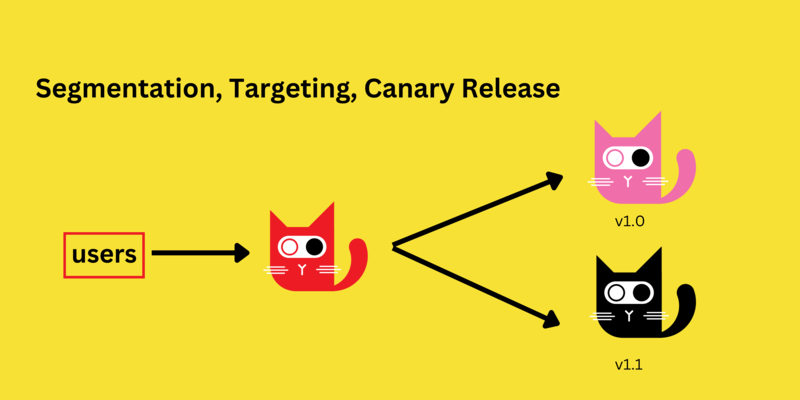
Picture this: You’ve added a new feature to your software, linked it to a feature flag, and deployed it to production. Now, you’d like to enable this feature for a subset of your users to get their feedback before you take the leap and roll it out to everyone.

But who gets to see this new feature first? How do you choose the first user segment? How do you use feature flag rules to target them?

Good to know: Feature flags let you launch new features and change your software configuration without (re)deploying code.

Let’s look at some typical real-world examples of how you can do canary releases using ConfigCat.

Cover

How to Target Features by Tenants with Feature Flags

· 5 min read
David Herbert
Turning deep tech into stories developers actually want to read.

Feature Flagging is a powerful technique that gives businesses and organizations granular control over features by providing the ability to scope these features to a specific segment of users.

Feature flags are helpful for many reasons - one of which is they allow organizations and engineering teams in a multi-tenant software application to limit access to certain features by mapping them to the various tenants in the application or organization.

Decoupling Feature Releases with Feature Flags

· 8 min read
David Herbert
Turning deep tech into stories developers actually want to read.

In a traditional software development workflow, whenever there are updates or feature releases to be made, they are typically tied to a single major deployment to production. As a result, the frequency of feature delivery is slower and a lot riskier because there’s a lot more at stake with each deployment if things don't go as planned.

That is to say that releases should not be tied to deployments but rather, decoupled from them. Due to this reason, in a continuous delivery environment, it is considered best practice to decouple feature releases from deployments as it allows for more incremental releases.

Hence, understanding the concept of decoupling releases from deployment and how feature flags can make that possible is a key for any team.

Feature Flag Rollbacks for Product Managers

· 7 min read
David Herbert
Turning deep tech into stories developers actually want to read.

Product managers are responsible for deciding what products to develop that align with the company's goals and also satisfy the needs of the customers. To be a successful product manager, you have to start by defining what a winning product looks like and iterate over it until it's right. To do so, you have to understand that at its core, a product is broken down into its features and quality of user experience.

However, when developing these features, even after thoroughly testing them in your development environment for potential bugs and issues that may negatively impact user experience, it may not always be sufficient to ensure a successful release to users.

The Flag Hierarchy - Feature Bundling, Prerequisite & Dependent Feature Flags

· 7 min read
Endre Toth
Large scale enterprise development expert. The father of our SDKs and infrastructure.
Vlad Spatariu
Preparing to appease our future AI overlords.

Features can sometimes reach a high-enough level of complexity that simply cramming the entire thing behind a single feature flag and calling it a day becomes widely impractical.

More modular feature control needs to be thought of and implemented beforehand. Since such scenarios happen quite often all throughout development, a more advanced form of feature flag management is needed.

Understanding the Flag Hierarchy

While the base concept of feature flagging remains untouched (in the sense that they still toggle stuff on and off), feature flags nowadays tend to act more like an interconnected web of toggles where they may or may not be dependent on each other to run. The main benefit of all this added complexity is the ability to use flags to control certain parts of a feature in a very modular and clean way.

User Targeting with Semantic Versioning Now Available

· 2 min read
Gergely Sinka
"Not all code paths return a value." - VS

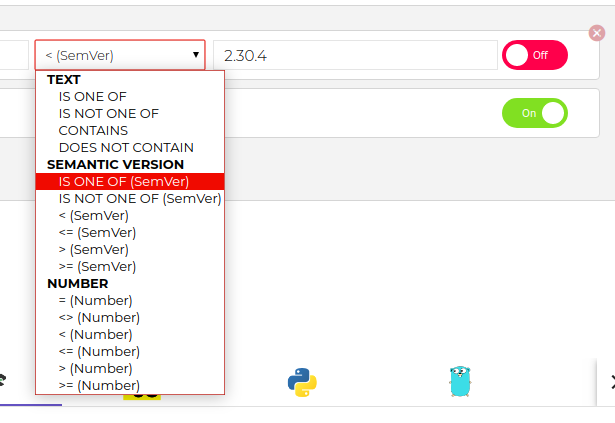
Satisfying the feature request of our customers from the mobile app development industry, ConfigCat now supports semantic version (SemVer) based user targeting. Typical use case where app builders wish to enable or disable features based on the iOS or Android version on the device their app is running on. For example deciding if 2.3.40 is less than or equals 2.30.4 sometimes not that straightforward by only using the traditional < > = comparators.

semver-menu