88 posts tagged with "feature management"

View All Tags

Feature Flag Variations: Structured Values for Multivariate and JSON Workflows

· 4 min read
Csilla Kisfaludi
Tech support by day, movie addict by night, crazy cat lady 24/7.

If you’ve ever wished your feature flag values worked more like enums, this update is for you.

Over the past years, we kept hearing the same request in different forms:

  • “Can we have enum-like values for feature flags?”
  • “Can we avoid people mistyping values?”
  • “Can we define JSON values once and just select it?”
  • “Can we separate flag definitions from rollouts?”

This usually came up when teams started using multivariate feature flags or working with more complex JSON feature flags.

Free-form values are flexible. But when feature flags become operational tools, toggled by Customer Success, Sustainment teams, or junior teammates, flexibility without guardrails becomes a risk.

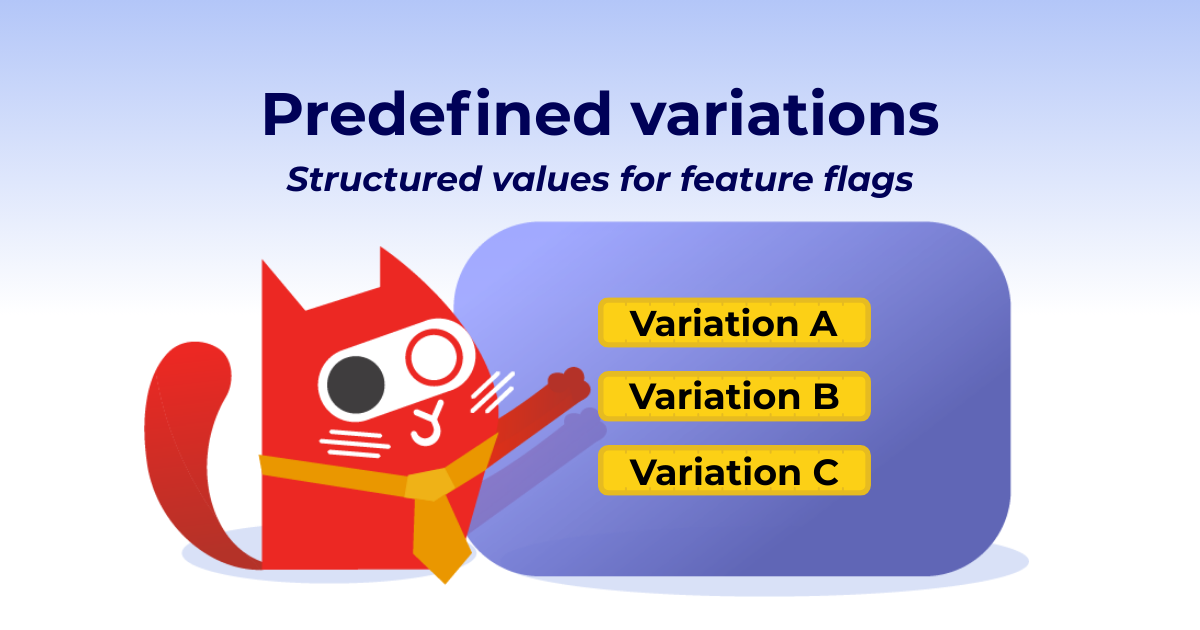
So we built Predefined variations.

ConfigCat Predefined Variations cover image

ConfigCat's Favorite Feature Flags and the Biggest Blunder in Feature Flag History

· 7 min read
Lajos Szoke
The one man army, who single-handedly built the heart and soul of ConfigCat.

At ConfigCat, we use the best feature flag provider in the world. Plot twist: it's ConfigCat. We're basically in a committed relationship with ourselves. Some call it narcissism; we call it quality control.

In this article, we'll share real-world feature flag examples from production, explain how we use our own system inside ConfigCat, and confess the biggest feature flag mistake we've ever made (so you don't have to repeat it).

ConfigCat standoff

Feature Flags in Flutter: Smarter Releases with ConfigCat

· 5 min read
Roxana Halați
I'm pretty cool, but I cry a lot.

Releasing new features in a mobile app can feel like walking a tightrope, especially when updates require going through lengthy App Store and Google Play review processes, and users still need to download the new build. That's where feature flags come in. They are software development tools that give developers the power to toggle features remotely, test new functionality safely, and control rollouts without shipping a new app version.

This guide shows you how to use feature flags in Flutter (Dart) with ConfigCat, focusing on best practices, manual polling, offline support, and real-world examples.

Best practices in Dart (Flutter) cover

How to Integrate Feature Flags in NestJS

· 8 min read
Chavez Harris
Inspiration does exist, but it must find you writing code.

Software development can be challenging, but deploying and managing new features shouldn't be. With feature flags, you can rest assured that your updates and new features are delivered safely with minimal risk. In this guide, I'll show you how to integrate a feature flag into a NestJS application.

How to use feature flags in NestJS cover

The Growing Community of ConfigCat

· 7 min read
Chavez Harris
Inspiration does exist, but it must find you writing code.

Before the open source movement, software programs were 'closed source,' meaning only software developers employed by the company could access and modify them. Outsiders were kept out through non-disclosure agreements and licenses. This exclusivity motivated the creation of the open-source movement, aiming to preserve the freedom to modify and distribute software through publicly accessible code. Today, many commercial companies actively participate in the open-source ecosystem, maintaining software that is open to the public for access and contributions. One such company supporting this effort is ConfigCat.

The growing community of ConfigCat cover image

Feature Flags: Build Your Own or Go with ConfigCat?

· 5 min read
David Herbert
Turning deep tech into stories developers actually want to read.

When it comes to shipping features fast and confidently, feature flags are your secret weapon. They let you roll out updates safely, test in production, and avoid deployment risks. But here's the big question: should you build your own feature flag system, or choose a ready-made solution like ConfigCat?

ConfigCat vs In-House Feature Management

Level Up Your Game - How Feature Flags Create Dynamic Player Experiences

· 5 min read
Emil Kovačević
Code hard, debug harder.

As the gaming industry continues to evolve, driven by technological advancement and an ever-growing demand for more immersive, engaging experiences, players no longer settle for static and predictable game worlds—they crave dynamic environments that respond and adapt to their actions in real-time.

This shift toward adaptive gaming revolutionizes development techniques, enabling developers to craft personalized gameplay as unique as the player behind the controller. At the heart of this transformation lies a powerful tool: feature flags.

Adaptive gaming with feature flags cover

Introducing Our New Rust SDK - Build Faster and Smarter

· 8 min read
Tímea Kopacz
I have approximate knowledge of many things.

Hey, Rustaceans! We developed the Rust SDK in response to a feature request from one of our customers, OneSignal. When we heard about their needs, we rolled up our sleeves and released the Rust SDK two months later. With it, you can manage feature flags like a pro—whether starting a new project or optimizing an existing app. It allows you to toggle features on and off without redeploying your code. That's right—no more redeploys every time your boss changes their mind about a button color!

With ConfigCat's feature flags, you can gradually roll out new features, rigorously test them (in a controlled environment, of course), and make changes on the fly—all directly from your dashboard! Let's dive into why this is a game-changer for your development workflow.

Introducing ConfigCat Rust SDK Cover

Optimizing Blue/Green and Ring Deployments with Feature Flags

· 8 min read
Roxana Halați
I'm pretty cool, but I cry a lot.

In software development, engineers and operations teams have a variety of deployment techniques, each with pros and cons. With so many options available, choosing the right release strategy can be challenging, especially when addressing specific problems.

In this blog, we will focus on two deployment strategies, blue/green and ring deployments, which aim to deploy software with minimal risk and disruptions, each using a different approach. These strategies can be applied to a variety of scenarios.

Coming up, we will explore how they work, their ideal use cases, their advantages and disadvantages, and, most importantly, how using a feature flag service like ConfigCat can enhance the flexibility and suitability of both blue/green and ring deployments to meet your specific needs.

Blue/Green and Ring Deployment Cover Photo

Using Feature Flags in Unreal Editor Scripts

· 7 min read
Chavez Harris
Inspiration does exist, but it must find you writing code.

Feature flags have equipped software developers to seamlessly roll out and roll back new features with the click of a button.

Due to their design and architecture, feature flags can be adapted and integrated into many languages and frameworks. They can be used with other technologies to enhance or add decoupled functionalities. Using them when scripting and automating your Unreal Engine editor is no exception to this.

Using feature flags with Unreal Engine python API